
.svg)



With over 40 years of experience in orthodontics, Dr. Sid Molayem has helped thousands of patients achieve healthier, straighter, and more confident smiles.
Straightening your teeth is about more than just appearance. Comfort, convenience, lifestyle, and confidence during treatment all matter too. Two of the most popular orthodontic options today are Invisalign and traditional braces.
Invisalign offers a discreet, removable way to straighten teeth, making eating and oral hygiene easier. Traditional braces provide a fixed, highly effective solution, especially for more complex alignment and bite issues.
Both treatments can deliver excellent results, but the right choice depends on your teeth, lifestyle, and treatment goals. Some cases respond well to clear aligners, while others benefit more from the precision of braces.
In this guide, we’ll compare Invisalign and braces, explain their key differences, and help you understand which option may be the better fit for your smile.
The benefits of straightening your teeth extend far beyond that cosmetic appearance. It contributes to better oral hygiene and enhanced overall physical health.
Choosing between Invisalign and metal braces is a big step towards a confident, healthier smile. While both of these methods achieve amazing results, the ideal choice aligns seamlessly with your daily lifestyle.
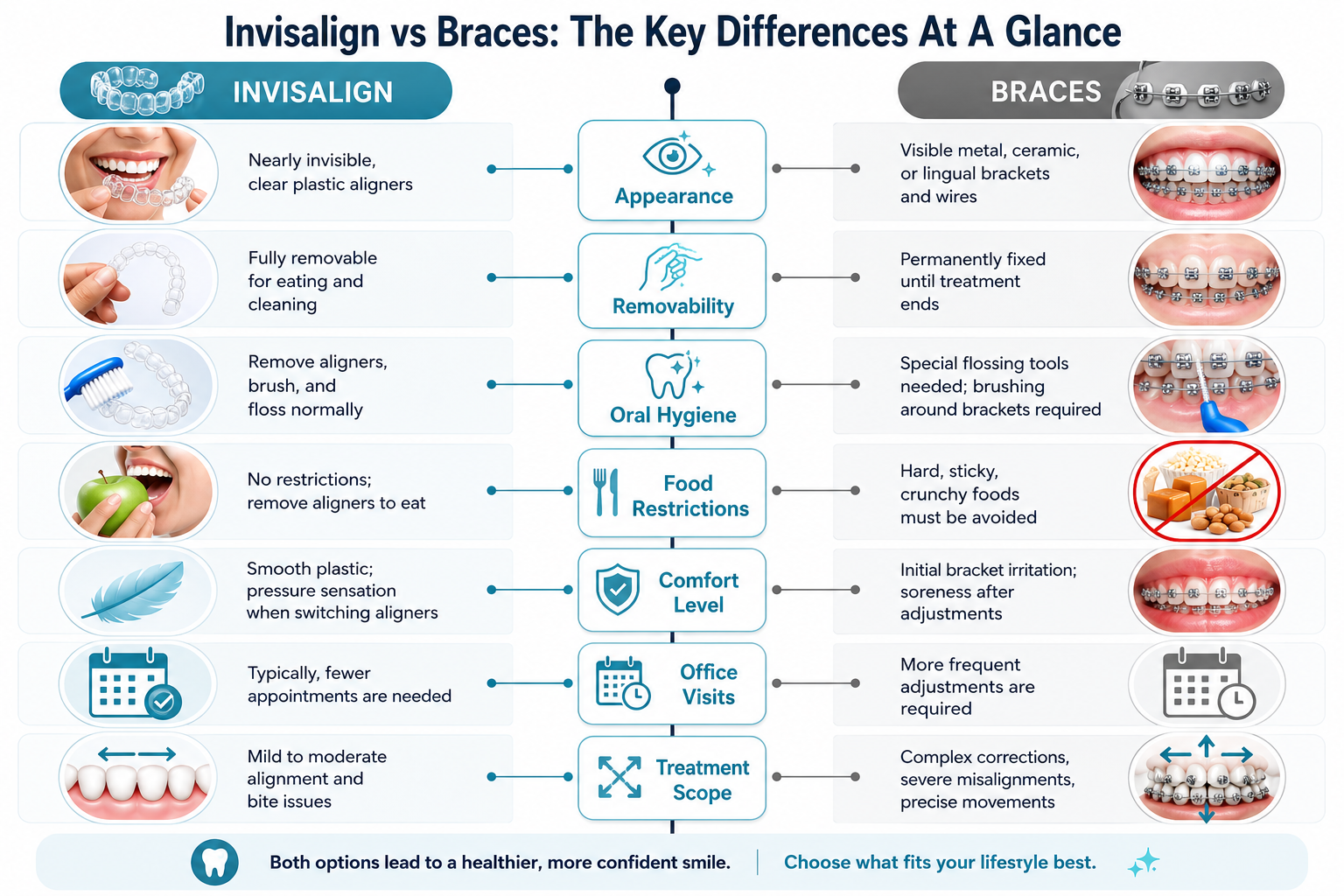
See the full Invisalign vs. Braces comparison infographic for a detailed breakdown of treatment differences:
Invisalign is a modern approach to tooth movement. It's a popular orthodontic system using invisible, clear, and removable aligners. These transparent, plastic aligners gradually shift teeth into the proper position.
Each custom-made tray applies gentle pressure on specific teeth. You switch to a new aligner roughly every one to two weeks.
The treatment process starts with 3D digital mapping. An expert orthodontist captures your teeth and creates a detailed roadmap showing each movement step.
These images guide the fabrication of your complete aligner set. You'll receive multiple sets at once or in stages. The entire approach works by stacking tiny, incremental changes. Rather than with sharp force, your teeth move millimeter by millimeter over a period of time.
Invisalign works best for mild to moderate alignment concerns. Spacing problems, crowding, and many bite issues respond well to this treatment.
However, some complex rotations and severe misalignments fall outside its scope. You need to remove aligners for eating, drinking, brushing, and flossing. Remember that such removability comes with your own responsibility. The treatment depends on consistent wear time, typically 20 to 22 hours daily.
If you skip wearing them, your teeth won't move as planned.
Traditional braces, also known as "Metal Braces," are a highly effective orthodontic treatment for correcting misaligned bites. This process uses brackets, wires, and bands to straighten teeth.
The practitioner attaches small metal or ceramic squares directly to each tooth. A thin metal wire runs through these brackets, exerting steady pressure. Changes in adjustments over time tighten the wire, continuing tooth movement. When it comes to complex bite patterns and severe misalignments, traditional braces excel at correcting them remarkably. They can handle cases that require precise, powerful tooth movement. Some orthodontists choose braces when a patient's case demands absolute control.
Its fixed nature means nothing relies on your compliance. Your teeth will continue to move steadily, whether you're remembering to wear something or not.
Modern braces come in several styles:
Regardless of style, the mechanics of the approach remain consistent: brackets and wires do the heavy lifting.
Needless to mention that you’re eating habits change during treatment. You ought to be careful, as hard, sticky, and crunchy foods can damage brackets or even bend wires. The practitioner will recommend special flossing tools to clean around the hardware.
Regular brushing becomes more involved, and dental appointments occur every 4 to 6 weeks for adjustments.
Choosing between braces and Invisalign depends on your budget, lifestyle, and dental needs. Both of these options carry genuine advantages and their fair share of real limitations.
Knowing both sides helps you make informed choices about your orthodontic future.
They're practically invisible: The first thing is they're pretty much invisible. Most people actually won't even notice you have anything in your mouth. And that’s really great if you want to keep your smile looking natural while you’re out and about.
You can eat whatever: With Invisalign, you don't really have to give up your favorite foods. If you think about it, you just take the trays out to eat. So, if you want popcorn or something sticky, you can just have it without worrying about breaking anything.
Brushing is easier: It's also way easier to brush and floss. Actually, since you can take them out, you don't have to deal with all that metal stuff in the way. It’s just way less of a hassle to keep things clean.
Fewer trips to the dentist: Moreover, there’s no need to run to the office as often. You might only need to go in every few months, which is honestly a lifesaver if you’re a busy person.
You have to be disciplined: Invisalign requires you to be actually disciplined. You have to wear them all the time, or they just won't work. Honestly, if you forget to put them in, there won’t be progress further.
They can't fix everything: If your teeth are super crowded or your bite is really weird, sometimes these trays just can't handle it. You might find out halfway through that you actually needed braces all along.
You have to keep them clean: you have to keep them clean all the time. You can't just leave them lying around or drink coffee with them in. Hence, it takes a bit of management every single day
They just work: The best thing about braces is that you don't have to worry about them. They’re stuck on your teeth and always working. You don't have to remember to put them back in or anything like that.
Braces handle the tough stuff: For those really tough cases, like if your teeth are completely misaligned, braces usually get the job done better. If you think about it, there’s a reason orthodontists use them for the hard stuff.
The price is usually about the same: They’re usually about the same price as Invisalign. It's not like you're saving a fortune, but sometimes insurance actually covers them a bit better.
No parts to lose: There’s no need to keep track of any removable parts. It’s just there. You don't have to worry about losing your trays or forgetting them at a restaurant.
Not Invisible: Unlike Invisalign, everyone can see your braces. If that makes you feel self-conscious, it can bug you a bit while you’re out.
You have to skip some snacks: As long as you’re wearing braces, you may have to give up some snacks. No popcorn, and sticky chocolates. It might be a little disappointing when you have to think about what you’re eating all the time.
Cleaning them is complicated: Trying to floss around all that metal? We understand that it’s difficult. You have to be very careful not to miss any spots.
They can hurt a little: At first, braces may cause some discomfort. Your cheeks might get scratched, and your teeth will feel pretty sore every time you tighten them.
Trying to figure out if Invisalign is actually the right move for your smile? It’s a big decision to make, and it’s not about what looks good. The treatment's usability depends on whether these Invisalign clear aligners fit your day-to-day life. These 5 signs can tell if you are the perfect match for the Invisalign process:
· You Want a Discreet Treatment Option
Client meetings, public speaking, or on-camera work often shape your self-image. Aligners blend into daily life without noticeably changing your appearance. You can maintain your professional image while your teeth are straightened behind clear plastic.
· When You Travel Constantly
If you frequently fly and change locations, aligners will suit you better than fixed braces. Neither is there any need for special hygiene tools, nor do you have to follow dietary restrictions. Your treatment continues seamlessly across time zones.
· Food Flexibility Matters to Your Quality of Life
Eating flexibly feels essential to your wellbeing. Are you someone whose dietary restrictions appeal to you strongly? With transparent aligners, no foods are off-limits during treatment. Aligners meet this need perfectly, as you simply remove them at mealtime.
· When your Orthodontic Case Falls Into the Mild to Moderate Range
If your teeth need spacing correction, minor crowding correction, or simple bite adjustments, Invisalign is the best option. Aligners can achieve your everyday goals. For smile transformation, complex tooth movements aren't required.
Certain dental situations really need that extra level of control that only fixed appliances can provide. Below are 5 distinct situations where orthodontists favor traditional fixed appliances over aligners:
· The Bite Problem Demands Precise Correction
Complex bite issues such as deep bites, open bites, or severe crossbites tend to respond best to braces. In these situations, your orthodontist will determine that aligner limitations don’t serve you adequately. Brackets and wires provide you with the firm control such a situation requires.
· Significant Crowding or Severe Misalignment
Sometimes, your teeth overlap substantially or sit in positions that are radically wrong. Certain rotations are more efficiently handled by aligners than by the former. Braces can feasibly tackle these severe cases with mechanical precision.
· Dietary Restrictions Don't Bother You
Are you someone who adapts easily to eating under restrictions for the time being? Braces are the perfect option for you. When you wear braces, avoiding hard or sticky foods temporarily is a MUST.
A flexibility like this removes one major disadvantage of a major brace from your personal equation.
· Cost Matters More Than Appearance
Braces often cost less than aligners. Insurance coverage typically includes braces more generously. If you have budgetary limitations, it’s better to invest in effective results, as this is one of the best & affordable orthodontic treatment options.
Budget-friendly treatment approaches take priority over cosmetic considerations.
The way you lead your life heavily determines whether aligners or braces can integrate seamlessly into your treatment.
Take a careful look at these 3 lifestyle dimensions. Your daily habits around eating, traveling, and professional situations significantly shape treatment success.
Neither option will work if it constantly conflicts with how you actually live.
Invisalign removes dietary restrictions. You can eat normally by briefly removing the aligners. At the same time, traveling requires minimal planning.
However, Braces constantly demand constant food consciousness. Sticky, hard foods potentially damage your brackets. Also, your travel dates must align with your orthodontist appointments.
Discipline vs Convenience: Invisalign requires consistent wear-time discipline. Nevertheless, it offers real meals-without-planning convenience quite perfectly. What significantly disrupts your progress is forgetting to replace your aligners—something often addressed in this [Invisalign care and wear Free guide].
Oppositely, braces eliminate wear-time variables entirely. They guarantee steady tooth movement but make flossing and appointments more tedious.
One of the most prominent advantages of Invisalign is that it disappears in photographs and meetings. You're able to maintain genuine confidence throughout treatment. Contrarily, for some patients, brace visibility impacts social confidence. How it will impact you professionally depends on your industry.
Client-facing roles can lead to occasional self-consciousness, while creative fields have minimal professional impact.
What Really Drives The Difference? The timelines for orthodontic treatments differ, and so do the cost structures. Costs and duration of Invisalign and braces depend far more on case complexity than on your choice. This surprises most patients.
As of 2026, Invisalign typically costs between $3,000 and $8,000 with a shorter, more flexible timeline of 6-18 months. On the contrary, traditional metal braces usually range from $2,500 to $7,000 and take 18-24 months.
Nonetheless, the total duration depends heavily on the case's complexity and patient compliance. Comprehensive planning at your consultation reveals realistic timelines. Some cases may get wrapped up in 12 months; others require 24 months or longer.
When you finally get in that chair for your consultation, you need to be ready to ask the right questions of the practitioner. Here is a quick checklist of aspects that you might consider before choosing one for yourself:
During a consultation, orthodontists decide between Invisalign and braces by evaluating the complexity of the case, including bite issues, tooth alignment severity, and jaw position. They also consider lifestyle factors, esthetic preferences, and whether the patient will reliably wear removable aligners. Braces are often recommended for more complex movements, while Invisalign is suggested for mild to moderate cases where compliance is likely.
Invisalign or Braces - the right choice aligns with your teeth, lifestyle, and goals.
At Beverly Hills Braces, we guide patients through this decision thoroughly and with utmost care. Our job is to help you understand exactly which option is best for you through clarity.
If you’re deciding between Invisalign and braces for adults or teens, the best next step is a consultation and a clear plan for your specific bite and goals.
Get in touch with us to schedule your consultation in Beverly Hills or Encino, or call the office to discuss options.
We examine your teeth, discuss your concerns, and explain which option actually matches your situation.
Invisalign effectively addresses many bite problems, including underbites, overbites, and crossbites of mild to moderate severity.
Complex bite patterns sometimes require braces instead. Your orthodontist evaluates whether aligners match your specific bite needs during your consultation.
Both treatments create discomfort differently. Invisalign pressure feels different from the soreness of braces. You’ll experience aligner switches that may create pressure sensations.
Brace adjustments can cause soreness and bracket irritation, and pain tolerance varies from person to person. Neither option causes severe pain consistently.
Sometimes switching works beautifully. We complete complex movements with braces, then finish refinement with aligners. Your specific case, treatment progress, and remaining goals determine whether switching makes sense.
Invisalign works well with sports. You can easily remove aligners during contact sports or wear a mouthguard over braces. Both accommodate athletic activity successfully. Your sport and protective gear preferences should align with your treatment choice.
Most whitening treatments work better after straightening finishes. Brackets and aligners prevent an even application of whitening. Professional whitening during treatment sometimes happens, but your orthodontist must clear it first. We suggest you discuss this desire at your consultation.
Invisalign is better for patients who want a more discreet, removable, and comfortable treatment, while braces are often better for severe or complex orthodontic cases. The right option depends on your bite, lifestyle, and treatment needs.
Yes. Invisalign requires more patient discipline because the aligners must be worn for 20–22 hours a day and removed only for eating, drinking, and cleaning. Unlike braces, Invisalign treatment success depends heavily on consistently wearing the aligners as directed.
Choosing an orthodontist is one of the most important healthcare decisions you'll make. You're not just choosing someone to straighten teeth—you're trusting them with your smile, your bite, and years of your life.
.jpg)
As a parent, you want to do everything right for your child's health. But when it comes to orthodontics, the timing can be confusing. Here's what you need to know.
.jpg)
It's one of the first questions everyone asks: "How long will I be in braces?" The answer depends on your case, not the calendar. But here's what you need to know to set realistic expectations.
Book your free consultation and get your personalized plan, smile simulation, and estimate today
Beverly Hills Braces is accepting and respectful of every patient’s dental needs and situation.
.svg)
.svg)
.svg)
.svg)
Copyright © 2026 Beverly Hills Braces.
All Right Reserved.
Quick Links
Copyright © 2026 Beverly Hills Braces.
All Right Reserved.

.svg)