
.svg)



With over 40 years of experience in orthodontics, Dr. Sid Molayem has helped thousands of patients achieve healthier, straighter, and more confident smiles.
When should your child see an orthodontist? It is a common question many parents have as they watch their kids grow and notice changes in their smile.
The timing for that first orthodontist visit can make a big difference in your child’s oral health. As your child grows, their baby teeth make way for the permanent teeth.
According to the American Association of Orthodontists, by age 7, most of these issues can be predicted.
Orthodontic treatment is about ensuring proper jaw alignment and function, critical for a child’s oral and overall health.
In this blog, we will explore the significance of early orthodontic treatment, what to expect, and the phases of treatment. We will further discuss the timing and benefits of orthodontic visits, as well as the types of early orthodontic treatment.
Read along and help your child achieve their healthy smile!
Early intervention orthodontic treatment refers to assessments and treatments that begin between the ages of 7 and 10. It is before the eruption of all permanent teeth. An orthodontist easily identifies minor issues with jaw development and tooth positioning at this age.
Proper care at an early stage allows interceptive treatment, which can reduce the severity of future orthodontic problems. It is a forward-thinking method that results in quicker and simpler treatments during adolescence.
The American Association of Orthodontists recommends that every child have their first orthodontic evaluation by age 7.
By this age, your child’s first adult molars usually appear, allowing the orthodontist to get a clear look at how their bite is taking shape.
At this stage, we can assess:
• How the back teeth fit together.
• Whether there’s enough space for incoming adult teeth.
• If the upper and lower jaws are developing in sync.
• Early signs of bite issues that could become more serious later.
It is more like a dental wellness visit. Most kids get reassurance and a plan to check back in a year or two, and some even benefit from early intervention.
During an initial orthodontic assessment, several essential measures are taken to evaluate your child's oral health and determine the appropriate course of action.
Here are the key things you can expect during the appointment:
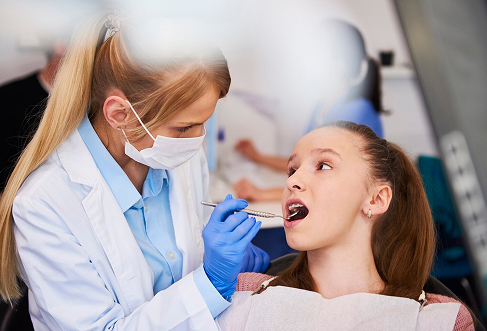
During your child's initial orthodontic assessment, the expert doctor will thoroughly examine the alignment of your child's upper and lower teeth as they bite. It helps identify alignment problems, overbites, underbites, or crossbites that may need correction.
During the assessment, detailed photographs or X-rays of your child's teeth are regularly captured. These pictures serve as crucial records and help assess the current state and progress throughout the treatment journey.
We can use dental scans to replicate your child's teeth and jaws. It allows for a detailed evaluation of their bite, tooth alignment, and the relationship between the upper and lower jaws. Digital scans provide essential information for treatment planning.
Once the orthodontist has gathered all the necessary information about the patient's teeth and jaw, it will be time for a consultation. The orthodontist will discuss an effective treatment plan with the patient and their caregivers. The orthodontist will address any inquiries and allow the patient to express concerns during this time.
Orthodontic treatment is not a one-step process. Some children reach optimal outcomes with a systematically organized, two-phase approach. Understanding the difference between Phase 1 and Phase 2 treatment helps parents make informed decisions about their child's dental care.
The primary purpose of Phase-1 early orthodontic treatment is to support jaw growth. It also ensures there is enough space for the permanent teeth to emerge properly.
By intervening promptly, orthodontists prevent major problems from developing. In some cases, they reduce the need for extractions or more complex procedures later.
About 15% of kids require early orthodontic intervention. Phase 1 is recommended for children with significant bite issues, concerns about jaw development, or severe crowding. It also includes behaviors such as thumb sucking that may affect dental growth.
• Space maintainers: Maintain open spaces where primary teeth may have been lost early. It ensures that permanent teeth get sufficient room to emerge.
• Palatal expanders: Widens the upper jaw to create extra space for emerging teeth.
• Partial braces: These braces for kids are applied to specific teeth to address initial alignment issues.
• Habit appliances: These devices are designed to prevent thumb sucking or tongue thrusting.
Generally, Phase 1 treatment spans 9 to 18 months, depending on the child's individual needs.
After initial treatment, most children enter a period of rest or observation. During this period, the orthodontist will monitor tooth development and eruption, preparing for Phase 2 after all permanent teeth have erupted. Generally, it is ideal for children aged between 11 and 14.
The focus of Phase 2 is to align all permanent teeth, improve the bite, and refine the smile's final appearance.
The majority of orthodontic patients require Phase 2 treatment. It ensures each tooth is positioned perfectly for optimal function and appearance.
• Full Traditional braces: These can be metal, ceramic, or transparent aligners such as Invisalign Teen, depending on your child's needs and preferences.
• Final bite correction: Adjustments to ensure the upper and lower teeth align correctly.
• Fine-tuning tooth position: Subtle adjustments to enhance the aesthetics and performance of the teeth.
Generally, Phase 2 therapy extends for 18 to 24 months.
Each child’s smile develops at a unique rate. But specific indicators may indicate the need for a professional assessment even before the advised age of 7.
Identifying these initial signs promotes proper growth of your child's teeth and jaws in healthy alignment, often simplifying future orthodontic treatment.
Here are some signs your child might benefit from early orthodontic care:
If your child has difficulty biting or chewing food correctly, it may indicate a bite issue.
Persistent mouth breathing may suggest airway problems or concerns about jaw development. It can impact sleep, development, and your child’s overall health.
Primary teeth fall out in a consistent order. If your child experiences tooth loss much earlier, like before age 4, or much later, after age 7-8, it is advised to have them examined.
If adult teeth are coming in very crowded or overlapping, prompt evaluation is helpful.
Evaluating clicking, popping, or discomfort in the jaw joint (TMJ) is necessary.
Some speech difficulties are related to tongue positioning or jaw alignment.
Children with highly prominent front teeth are at a greater risk of harming them during falls or while playing sports. Timely intervention can lower this risk.
If your child continues to suck their thumb beyond age 5-6, it may impact jaw and tooth growth.
If you notice any of these symptoms, schedule a consultation with the expert doctors.
Scheduling your child’s first orthodontic evaluation at an early age offers valuable advantages and highlights the health benefits of orthodontic treatment, even if no immediate treatment is needed.
Here’s how early orthodontic attention can set your family up for long-term success:
1. Peace of Mind:
Knowing that your child’s smile is developing normally can relieve anxiety and uncertainty. Early evaluation allows you to address any concerns right away, so you can feel confident about your child’s oral health.
2. A Roadmap for the Future:
An orthodontist can provide a clear plan for how your child’s teeth and jaws are expected to develop, along with guidance on what to watch for as they grow. You’ll know when to expect future checkups or possible treatment, so there are no surprises.
3. Prevention of Bigger Problems:
Early detection of dental or jaw issues means they can be managed before they become more complicated or more costly to fix. Preventive care may mean less invasive treatment and better results down the road.
4. Time to Plan and Prepare:
If orthodontic treatment is likely in the future, early evaluations give your family time to consider options, prepare your child emotionally, and budget for potential costs. With more time, you can make decisions that work best for your family.
5. Building a Positive Relationship
Early visits help your child become comfortable with the orthodontist and the office environment. Building this trust makes future treatments less stressful and more successful, and encourages a positive attitude toward dental care for years to come.
Orthodontic treatments help guide appropriate development, address bite issues, and, occasionally, prevent the need for more complex treatment in the future.
Here’s a brief overview of the most common types of early orthodontic interventions.
These are fixed or detachable devices that maintain the gap created by an early lost primary tooth. It prevents the adjacent teeth from moving and ensures the correct emergence of the permanent tooth.
Space maintainers are usually made of acrylic or metal and are primarily used for children who lose a front tooth prematurely.
A palatal expander is a removable device utilized to enlarge a constricted upper jaw. It provides space for overcrowded teeth and encourages proper alignment of adult teeth. The expander gradually enlarges the upper palate seam as it is periodically adjusted.
These are permanent devices that include a slender metal wire attached to the rear molars on each side of the upper arch.
They help correct a posterior crossbite, a condition in which the upper molars occlude within the lower molars. These arches gently push the upper molars outward, establishing a proper bite.
Like trans palatal arches, lingual arches are fixed devices attached to the back of the lower front teeth.
They help in fixing an anterior crossbite, where the upper front teeth bite inside the lower front teeth. Lingual arches exert a mild force to move the lower front teeth outward.
Transparent and removable aligners are gaining popularity for early orthodontic treatment.
Invisalign clear aligners are a set of customized, comfortable plastic trays that gently guide teeth into proper alignment. They are a less invasive solution and work best for slight crowding or spacing problems.
Many parents get concerned that the initial orthodontic visit will be overwhelming or that they'll be compelled to begin treatment immediately.
The purpose of this first visit is to understand your child's smile, address your questions, and, if necessary, establish a plan.
Here’s what you can expect when you arrive for your child’s initial checkup.
1. Exam and Assessment
The teeth, jaw, and bite of your child will be thoroughly assessed. Images or X-rays may be taken to get a thorough understanding of what is happening, even underneath the surface.
2. Discussion
The orthodontist will discuss their observations and clarify if any treatment is suggested at this time or may be required in the future.
3. Timeline
If treatment is not necessary at this time, you will be informed when to come back for monitoring, usually every 6-12 months.
4. Questions
You'll have plenty of time to inquire and explore all your choices, allowing you to reach a well-informed conclusion.
5. No Pressure
An experienced orthodontist won't rush you into undergoing treatment. Their role is to provide details and help you determine what's best for your child and family.
An early visit to an orthodontist does not mean early treatment; it is about ensuring that your child’s teeth and jaws are developing properly. A proper checkup provides peace of mind and a clear plan for your child’s healthy and happy smile.
If you’re wondering whether your child is ready for their first orthodontic visit, our team at Beverly Hills Braces is here to help.
Our expert orthodontist for kids and adults, Dr. Molayem, will personally evaluate every patient and ensure optimal outcomes. Schedule a consultation to get expert guidance and answers to all your questions.
Reach out to us and let your child enjoy a friendly, stress-free evaluation and take the first step toward a healthy smile.
Choosing an orthodontist is one of the most important healthcare decisions you'll make. You're not just choosing someone to straighten teeth—you're trusting them with your smile, your bite, and years of your life.
.jpg)
As a parent, you want to do everything right for your child's health. But when it comes to orthodontics, the timing can be confusing. Here's what you need to know.
.jpg)
It's one of the first questions everyone asks: "How long will I be in braces?" The answer depends on your case, not the calendar. But here's what you need to know to set realistic expectations.

Book your free consultation and get your personalized plan, smile simulation, and estimate today
Beverly Hills Braces is accepting and respectful of every patient’s dental needs and situation.
.svg)
.svg)
.svg)
.svg)
Copyright © 2026 Beverly Hills Braces.
All Right Reserved.
Quick Links
Copyright © 2026 Beverly Hills Braces.
All Right Reserved.

.svg)