
.svg)



With over 40 years of experience in orthodontics, Dr. Sid Molayem has helped thousands of patients achieve healthier, straighter, and more confident smiles.
Most people think straight teeth mean a healthy smile—but your bite matters just as much. The real secret to a healthy smile? How your teeth fit together. That's your bite, and it matters more than most people realize.
A misaligned bite can quietly cause jaw pain, uneven tooth wear, and long-term damage — even when your teeth look perfectly straight. Whether you're exploring braces or Invisalign, understanding occlusion is the first step toward a smile that's both beautiful and built to last.
In this guide, we break down what a healthy bite looks like, what goes wrong with malocclusion, and how orthodontic treatment can fix it for good.
Occlusion refers to how your upper teeth meet your lower teeth when you bite, chew, and move your jaw. When alignment is correct, everything works smoothly, with teeth sharing pressure evenly instead of overloading a few points.
A healthy bite alignment focuses on the over function. Your jaw should close comfortably without strain or clicking, and your teeth should contact evenly across the bite. During movement, your teeth should work together without grinding or slipping.
Most of the time, people don’t notice a problem until symptoms appear. Jaw tension, uneven chewing, or one side doing more work can signal an issue. These problems often develop gradually, which makes early awareness essential.
A well-functioning bite protects your mouth over time. It’s not just about comfort but also about preventing costly dental problems. When your teeth contact evenly, forces are distributed properly. If they don’t, certain teeth take excessive pressure while others remain underused.
Your back teeth handle most chewing forces. When occlusion is balanced, they absorb pressure while the front teeth guide movement. An uneven bite shifts force to weaker teeth, causing wear, chipping, and sensitivity.
Gum recession can follow uneven pressure, specifically on overloaded teeth. Gradually, your gums pull back, exposing roots and increasing sensitivity. A properly aligned bite helps prevent this gradual damage.
Your jaw relies on proper alignment to function comfortably. When teeth fit correctly, your buccal muscles work efficiently. They seamlessly allow smooth chewing, speaking, and movement without strain.
An improper bite forces muscles to overwork, leading to tension, headaches, and fatigue. In this regard, a balanced bite supports natural jaw function and reduces long-term discomfort.
There are a plethora of benefits of straightened teeth. Well, to be specific, straight teeth don’t always mean a healthy bite. Teeth may appear aligned, but still create uneven pressure. It can lead to wear, jaw issues, and instability going forward.
Effective orthodontic treatment focuses on both appearance and function. The goal is a balanced bite that supports long-term oral health, and not just a visually straight smile.
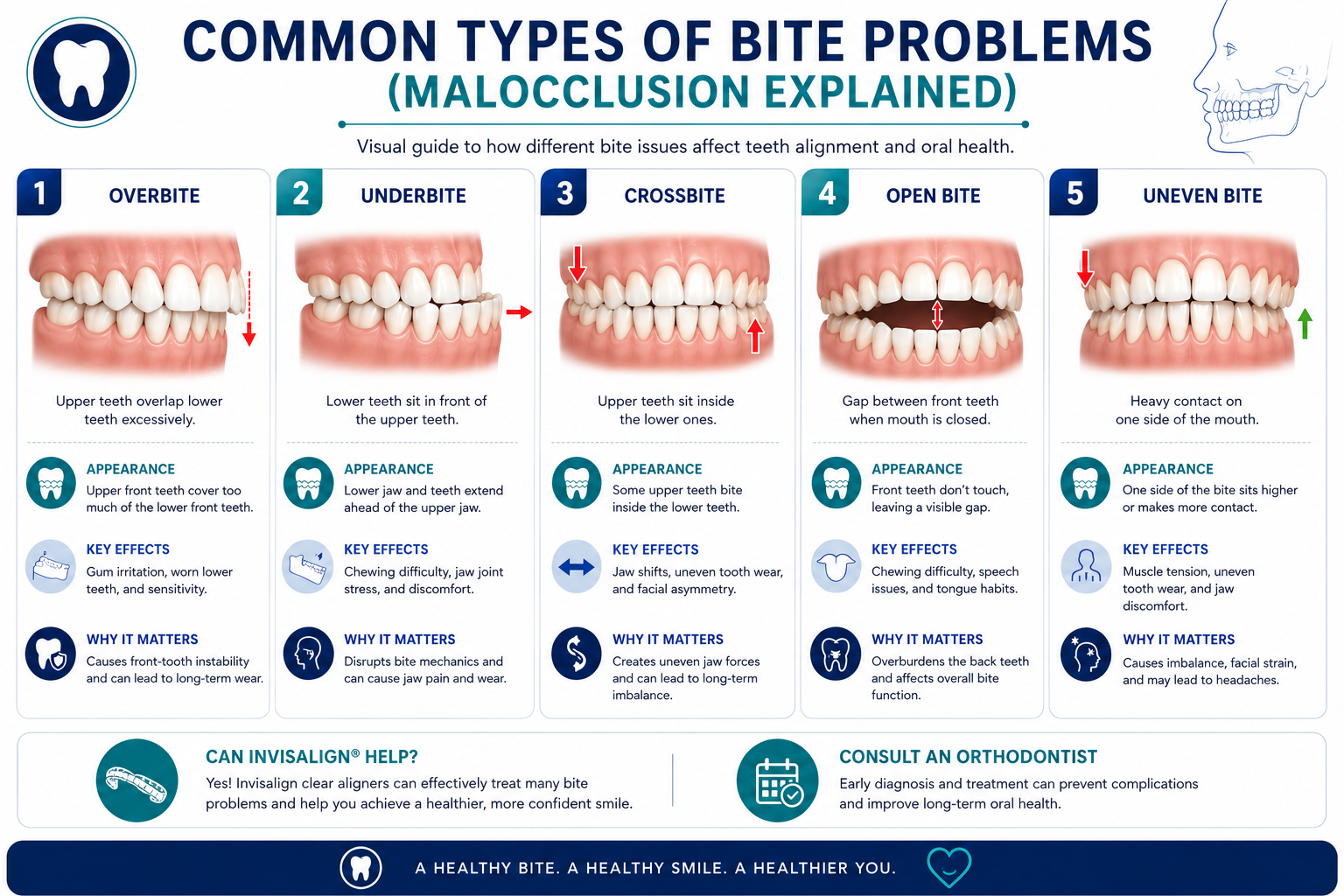
Malocclusion is the medical term for a bite that doesn't fit together properly. Without even contact, the bite creates uneven pressure and force distribution across the teeth.
A problem like this can range from minor to severe, affecting how your mouth functions.
Malocclusion also develops due to your genetics, jaw, and tooth size differences. Furthermore, habits like thumb sucking or tongue thrusting contribute significantly.
Some people inherit it, while others develop it over time. Early detection allows orthodontists to treat it more effectively.
Healthy occlusion refers to the specific condition in which your teeth contact evenly when you close your mouth. In this case, the pressure is balanced, and your jaw moves smoothly without discomfort, clicking, or shifting.
Malocclusion disrupts this kind of balance. Some of your teeth may not touch, or your jaw may shift while closing. Most of the time, you'll find that chewing feels uneven or uncomfortable.
Even if it looks normal, underlying functional problems may still exist. A condition like this makes the professional evaluation important.
During childhood and adolescence, bite problems develop gradually when no one notices. As adult teeth grow in, genetics and available space determine their position. A smaller jaw can cause crowding, while uneven jaw growth can lead to an overbite condition.
Certain habits, like mouth breathing or tongue thrusting, can worsen these issues. Treatment is easier during childhood, but adults can still correct malocclusion with modern orthodontic solutions.
To be honest, bite problems don't tend to announce themselves loudly. Instead, they create subtle, minimal signals that indicate it's time for you to give attention. It's essential for you to recognize these warning signs as early as possible to catch problems before any serious damage.
Take a look at the points below
• Uneven Tooth Wear and Visible Damage
Your teeth reveal how your bite functions daily. If one side wears down faster, that's a red flag. Flattened edges indicate excessive pressure, causing damage that accelerates over time.
• Jaw Tension, Clicking, or Discomfort
Jaw clicking or popping when opening suggests your joint isn't perfectly aligned. Tension after eating implies that your muscles are working too hard. To be specific, even mild discomfort warrants attention because it typically worsens later.
• Headaches That Seem Connected to Chewing
Unexplained headaches often stem from bite problems. When jaw muscles overcompensate for an improper bite, tension builds quickly. If your headaches coincide with chewing discomfort, mention this during your consultation.
• Gum Recession Around Specific Teeth
Gums recede when teeth bear excessive force, pulling away over the years. If gums retreat around specific teeth, exposed roots become sensitive. Correcting your bite early prevents serious issues like grafting.
• Difficulty Chewing or Food Avoidance
If chewing causes discomfort, you might unconsciously favor one side. Avoiding hard foods to escape pain reinforces this imbalanced cycle. You should chew comfortably on both sides; please seek evaluation.
TMJ bite issues can quietly affect how your jaw feels every day. When your bite doesn’t line up right, your jaw joints (TMJ) don’t move as smoothly as they should. That can create small imbalances at first -maybe a slight click, some tightness, or discomfort while chewing.
Eventually, though, it can get worse. Your muscles start working harder to compensate, and that leads to tension, headaches, or even pain around the ears and neck.
You may also notice jaw fatigue after talking or eating. It’s not always obvious at first, which is why many people ignore it until it becomes harder to manage.
Orthodontics for bite correction aims for more than aesthetics. It ensures your teeth connect and function efficiently. Professionals analyze jaw alignment and force distribution to move teeth into positions for optimizing stability and oral health.
With gentle, consistent pressure over several months, the right orthodontic treatment shifts your teeth through the bone density effectively. Professionals use both braces and clear aligners depending on the specific case. They apply calculated forces on your teeth to stimulate the natural process of bone remodeling.
As the tooth moves slowly, the bone around the root dissolves on the pressure side. At the same time, the new bone grows behind it, which allows the tooth to relocate.
Under the precise guidance of the practitioner, such a biological transformation occurs over a period of time. Your orthodontist maps these movements in 3 dimensions, accounting for how each shift affects your overall bite mechanics. Braces provide continuous pressure, whereas Invisalign clear aligners utilize sequential trays to guide teeth. Well, the timelines for each method vary significantly, but you need to have patience throughout this process. A permanent, functional result that enhances your long-term dental health is just an appointment away.
· Overbite Correction
An effective treatment, including Invisalign with attachments and elastic, accompanies braces and can move upper front teeth backward and lower front teeth forward simultaneously. The sole objective is to reduce the overlap.
If you're a teenager, your orthodontist might restrict upper jaw growth. It allows your lower jaw to catch up in a proportionate way. This prevents excessive wear and restores proper protective guidance of front teeth.
· Underbite Correction
Underbite requires moving the lower front teeth backward and the upper front teeth forward to reverse the improper relationship. If you're still growing, treatment like traditional braces with elastic might encourage upper jaw growth while restricting lower jaw growth.
Complex underbites sometimes benefit from surgical correction coordinated with orthodontic treatment.
· Crossbite Correction
Braces with cross-elastics expand your upper jaw width slightly while moving individual teeth into proper positions. Crossbites at the front of your mouth require careful movement of specific teeth to sit properly.
Back tooth crossbites might involve expansion of your upper jaw arch to allow proper positioning. Correcting crossbites prevents the jaw from shifting and the asymmetrical wear patterns they create.
· Open Bite Correction
Open bite correction specifically addresses the gap between front teeth by carefully moving them closer together. Sometimes it also involves rotating teeth to optimize contact.
Early orthodontic treatment involves restricting upper front tooth eruption and encouraging lower front teeth to move upward. Behavioral changes are required apart from orthodontic treatment to correct open bites connected to the tongue.
A comprehensive orthodontic bite evaluation goes far beyond looking at your teeth. An expert examines how your entire bite functions by taking into account jaw position, muscle strength, and movement patterns.
The detailed assessment below determines your treatment plan and predicts how your bite will improve through orthodontic correction:
Understanding why your bite is off is the first step to fixing it. Sometimes it’s just tooth position, but actually, other issues that come from jaw alignment or old habits like mouth breathing.
Your orthodontist will use X-rays and 3D scans to see what’s really going on. Checking your history is also a part of the diagnosis. It’s all about finding the actual root cause, so that they can plan a treatment that really works for your specific needs.
Once they have the information, your orthodontist creates a custom plan curated just for you. They’ll map out exactly how your teeth need to move and when. By explaining pros/cons and comparison, they’ll walk you through two effective options - Traditional braces or Invisalign.
These experts will also cover the timeline and cost for each, along with any potential hiccups you might run into.
For instance, if you want a smile that stays discreet, Invisalign is great. But you honestly need to be disciplined enough to keep the trays in all day.
Braces don't give you that same freedom to take them out. However, they’re actually the better pick if you prefer a "set-it-and-forget-it" approach.
If you've never had your bite problems symptoms professionally assessed, now's the time to go for an evaluation. Many people live with bite problems they don't realize are easily fixable.
Early intervention during childhood and adolescence requires less extensive treatment than adulthood. However, when it comes to adult orthodontics, you can achieve excellent results at any age with modern techniques.
If you experience jaw discomfort, notice uneven tooth wear, have difficulty chewing, or see gum recession around specific teeth, get your bite checked.
Moreover, if you breathe through your mouth or have a family history of bite problems, schedule an evaluation without any second thought. Minor bite problems also deserve professional assessment as they can often worsen without intervention. Additionally, if you suddenly notice your bite alignment feels "off," it's an indication that you need a diagnosis.
Understanding your bite is the very first step towards protecting your oral health for decades. In this blog, we've explored what occlusion and malocclusion mean, why bite alignment matters, and how orthodontists correct these problems.
Now it's time to determine whether your bite needs professional attention. If you are unsure about your bite, or you have symptoms like uneven wear, jaw tension, or a bite that feels “off,” a bite evaluation can help clarify what is happening and what options make sense.
If you are in Beverly Hills or Encino, Beverly Hills Braces can evaluate your occlusion and discuss orthodontic options that prioritize both appearance and function. Schedule a consultation with us today.
Our team evaluates your bite alignment comprehensively by addressing both cosmetic and functional concerns. We've helped several patients transform their bites and their lives through expert orthodontic care.
Prefer to talk first? Get in touch with us at: (310) 278-9101.
Choosing an orthodontist is one of the most important healthcare decisions you'll make. You're not just choosing someone to straighten teeth—you're trusting them with your smile, your bite, and years of your life.
.jpg)
As a parent, you want to do everything right for your child's health. But when it comes to orthodontics, the timing can be confusing. Here's what you need to know.
.jpg)
It's one of the first questions everyone asks: "How long will I be in braces?" The answer depends on your case, not the calendar. But here's what you need to know to set realistic expectations.
Book your free consultation and get your personalized plan, smile simulation, and estimate today
Beverly Hills Braces is accepting and respectful of every patient’s dental needs and situation.
.svg)
.svg)
.svg)
.svg)
Copyright © 2026 Beverly Hills Braces.
All Right Reserved.
Quick Links
Copyright © 2026 Beverly Hills Braces.
All Right Reserved.

.svg)